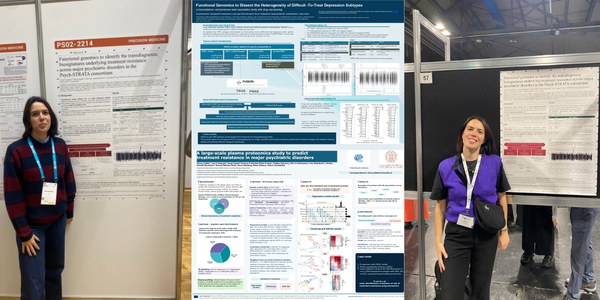
Psych-STRATA researchers presented new findings at the World Congress of Psychiatric Genetics (WCPG) 2026 and the 39th ECNP Congress in Munich, Germany. The scientific posters highlighted progress in understanding treatment resistance in schizophrenia, bipolar disorder, and major depressive disorder.
The research explored genetic and biological factors that may influence treatment outcomes. It also examined how these findings could contribute to more personalised approaches to mental health care.
Exploring Genetic Factors Behind Treatment Resistance
Poster: Functional Genomics to Identify the Transdiagnostic Biosignatures Underlying Treatment Resistance Across Major Psychiatric Disorders examined genetic factors linked to treatment resistance across three psychiatric conditions.
Researchers analysed gene and protein expression to identify biological mechanisms that may influence treatment response. The findings highlighted several genetic associations in major depressive disorder, including genes involved in brain development and neuronal function.
Although the number of significant findings was limited, the results point to further research into biological factors shared across psychiatric disorders.
Another poster, Functional Genomics to Dissect the Heterogeneity of Difficult-To-Treat Depression Subtypes, explored biological differences between four forms of depression, including recurrent depression and depression associated with suicidal thoughts.
The study identified 42 significant gene-expression associations in recurrent depression and 11 in depression with suicidal thoughts. Researchers also explored whether existing medicines could be used for different depression subtypes.
The findings suggest that different forms of depression may have distinct biological characteristics. This could help guide future research into more personalised treatment approaches.
Investigating Proteins to Improve Treatment Prediction
The third poster, A Large-Scale Plasma Proteomics Study to Predict Treatment Resistance in Major Psychiatric Disorders, presented findings from a study involving 860 participants with schizophrenia, bipolar disorder, or major depressive disorder.
Researchers examined thousands of proteins to identify biological patterns associated with treatment resistance. Their analyses highlighted proteins involved in immune processes, cell adhesion, and cellular signalling.
The team continues to validate these findings using independent patient samples. The aim is to identify biological markers that could help predict treatment resistance earlier.
By presenting these findings at international scientific conferences, Psych-STRATA researchers shared their progress with the wider research community. The studies support the project’s ongoing efforts to understand treatment resistance better and explore more personalised approaches to mental health treatment.
Learn more about us. Follow the project on LinkedIn, X and Bluesky.